Chimpanzees are widely considered the most intelligent animal after humans due to their remarkable cognitive abilities and genetic similarity to humans. What’s truly astonishing is that these primates share approximately 98.7% of their DNA with humans, making them our closest living relatives in the animal kingdom.
- Chimpanzees share 98.7% DNA with humans and demonstrate complex problem-solving abilities
- Scientists measure animal intelligence through brain size, problem-solving tests, and communication skills
- Other highly intelligent animals include dolphins, orangutans, elephants, and bonobos with specialized cognitive strengths
Chimpanzees: Our Closest Living Relatives with 98.7% DNA Similarity
Chimpanzees stand as the most intelligent animal after humans primarily due to their remarkable genetic relationship. Scientific research confirms that these primates share approximately 98.7% of their DNA with humans, making them our closest living relatives in the animal kingdom.
This genetic proximity isn’t merely a biological curiosity—it directly correlates with similar cognitive capabilities that have fascinated scientists for decades. The shared evolutionary history has resulted in comparable brain structures, neural pathways, and problem-solving mechanisms that allow chimpanzees to demonstrate intelligence that often mirrors aspects of human cognition.
Complex Tool Use and Problem-Solving Abilities in Chimpanzees
The cognitive abilities of chimpanzees extend far beyond instinctual behaviors, revealing sophisticated intelligence through their actions:
- Tool creation for hunting: Chimpanzees fashion sticks to extract termites from mounds and modify stones to crack nuts
- Strategic warfare tactics: They exhibit organized group hunting with coordinated strategies and even engage in inter-community conflicts
- Human language acquisition: Some chimpanzees have learned hundreds of signs in American Sign Language and can form simple sentences
- Complex problem-solving: They demonstrate the ability to solve multi-step puzzles and plan for future needs
These abilities demonstrate that chimpanzee intelligence goes beyond simple instinct, showing evidence of abstract thinking, planning, and cultural transmission of knowledge across generations.
How Chimpanzee Intelligence Compares to Human Cognition
Research comparing chimpanzee and human cognitive abilities yields fascinating results. In memory tests, adult chimpanzees scored similarly to college students, while adolescent chimps sometimes outperformed human participants in specific cognitive tasks. Studies have shown that chimpanzees can remember number sequences with greater accuracy than humans in certain experimental conditions.
However, humans maintain advantages in language complexity, abstract reasoning, and cumulative culture. This comparison reveals that intelligence exists on a spectrum rather than as a binary trait, with chimpanzees demonstrating remarkable cognitive abilities that challenge our understanding of what constitutes intelligence in the animal kingdom.
How Do Scientists Measure Animal Intelligence?

Brain Size and Complexity as Intelligence Indicators
Scientists assess potential animal intelligence by examining brain structure and size relative to body mass—a metric known as encephalization quotient. The bottlenose dolphin exemplifies this approach, possessing a brain second only to humans in relative size and complexity. Their large cerebral cortex, with extensive folding similar to human brains, suggests advanced cognitive processing capabilities.
However, brain size alone doesn’t determine intelligence; scientists also examine neural connectivity, specialized brain regions, and neurotransmitter systems. This multifaceted approach allows researchers to identify species with the biological potential for sophisticated cognition, providing a foundation for further behavioral testing and observation.
Problem-Solving Tests and Cognitive Experiments
Scientists employ various experimental methods to measure animal intelligence in controlled settings:
- Puzzle-solving tasks: Animals must manipulate objects to obtain rewards, testing their ability to understand cause-and-effect relationships
- Tool-use challenges: Subjects must create or modify tools to solve problems, assessing innovation and planning abilities
- Memory tests: Researchers evaluate spatial memory, recall of sequences, and recognition of individuals
- Social cooperation experiments: Animals work together to achieve goals, measuring their understanding of social dynamics and reciprocity
Chimpanzees have excelled in these tests, demonstrating the ability to solve complex problems that require multiple steps and planning ahead. Their performance in these experiments provides concrete evidence of their advanced cognitive capabilities.
Communication Skills and Self-Awareness Measures
Scientists evaluate animal intelligence through communication abilities and self-awareness using several key methods. The mirror test determines self-awareness by observing if an animal recognizes itself in a reflection—elephants, dolphins, and great apes typically pass this test. Symbol comprehension tests measure an animal’s ability to understand and use abstract representations, with some chimpanzees learning hundreds of symbols.
Vocalization analysis examines complex communication patterns, particularly evident in dolphins with their signature whistles and elephants with their infrasonic communication. These methods collectively provide a comprehensive view of animal intelligence beyond simple problem-solving, revealing the depth of cognitive abilities across different species.
Other Highly Intelligent Animals Beyond the Top Contender
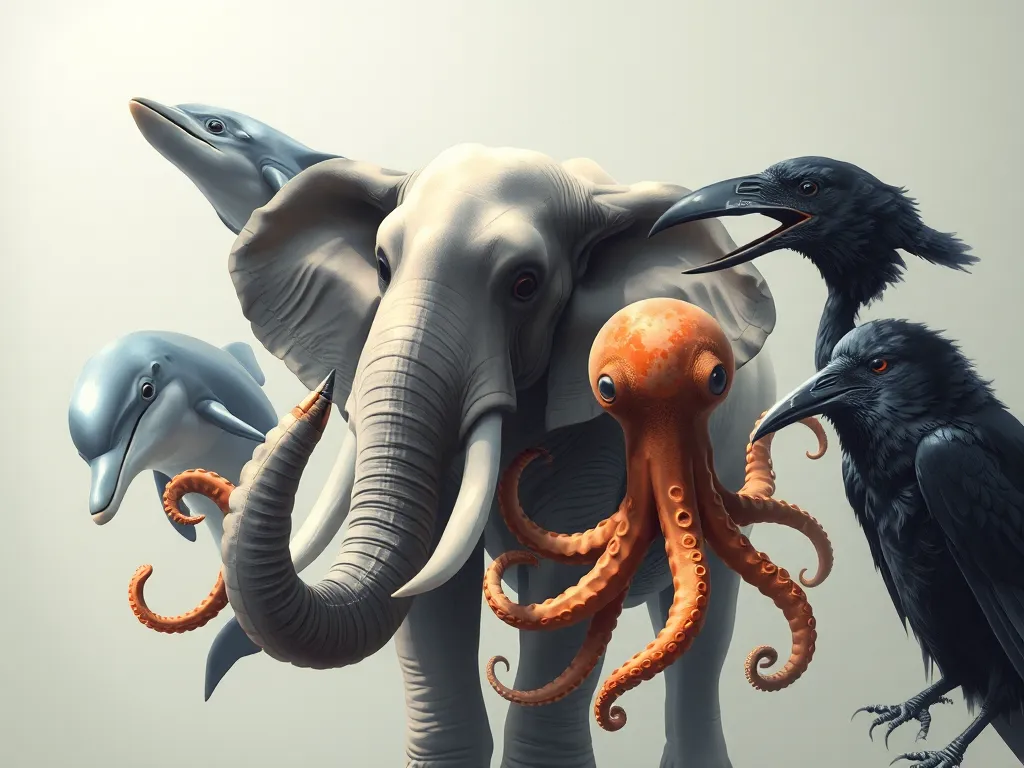
Comparing Intelligence Levels: Top Contenders After Chimpanzees
| Species | Key Cognitive Abilities | Specialized Intelligence Type | Notable Research Findings |
|---|---|---|---|
| Bottlenose Dolphins | Complex communication, self-recognition, problem-solving | Social and linguistic intelligence | Demonstrate signature whistles as names, show empathy toward injured pod members |
| Orangutans | Tool use, planning, nest building, memory | Technical and spatial intelligence | Create elaborate nightly nests, plan future food sources, discuss past events |
| Elephants | Self-awareness, grief, compassion, social bonds | Emotional and social intelligence | Mourry deceased members, cooperate to solve problems, recognize themselves in mirrors |
| Bonobos | Empathy, cooperation, conflict resolution | Social and emotional intelligence | Use communication to resolve conflicts, share food, console distressed individuals |
Specialized Intelligence: Different Types of Animal Cognition
Different species demonstrate distinct forms of intelligence rather than existing on a single linear scale. Elephants excel in social and emotional intelligence, maintaining complex social structures with strong family bonds and demonstrating empathy toward other species. Dolphins showcase sophisticated linguistic abilities with their signature whistle “names” and can follow pointing gestures—a skill rare in the animal kingdom.
Orangutans demonstrate exceptional technical intelligence, creating tools, planning future actions, and constructing elaborate nests. Bonobos exhibit remarkable empathetic intelligence, using communication to resolve conflicts and sharing resources without aggression. These specialized cognitive abilities evolved to serve different ecological niches and survival strategies, revealing the diverse ways intelligence manifests across species.
Studying animal intelligence fundamentally challenges our anthropocentric view of cognition, revealing that intelligence takes many forms beyond human-like reasoning. You can observe these remarkable cognitive abilities firsthand by watching nature documentaries that showcase problem-solving behaviors, visiting wildlife rehabilitation centers that work with intelligent species, or even noticing the clever adaptations in your own pets. Consider exploring primate research centers or cognitive studies that demonstrate how animals think and solve problems—such experiences will forever change how you perceive intelligence in the natural world.