Bats navigate and hunt in complete darkness using echolocation, a biological sonar system. They emit high-pitched, ultrasonic clicks ranging from 9 to 200 kHz from their mouths or noses, which bounce off objects and return as echoes.
By analyzing these returning sounds, bats create a mental 3D map to determine the size, shape, distance, and texture of objects, allowing them to navigate and catch prey without light. This process happens in real-time, enabling bats to fly through complex environments like caves and forests at speeds up to 60 km/h without collision.
Key Takeaways
- Bats emit ultrasonic clicks between 9 to 200 kHz to map their surroundings.
- During intense hunting, some bats emit up to 200 clicks per second.
- Echolocation allows bats to detect objects as thin as a human hair.
- Specialized ear anatomy and brain processing enable real-time 3D spatial mapping.
How Bats Emit and Interpret Sound Waves for Echolocation
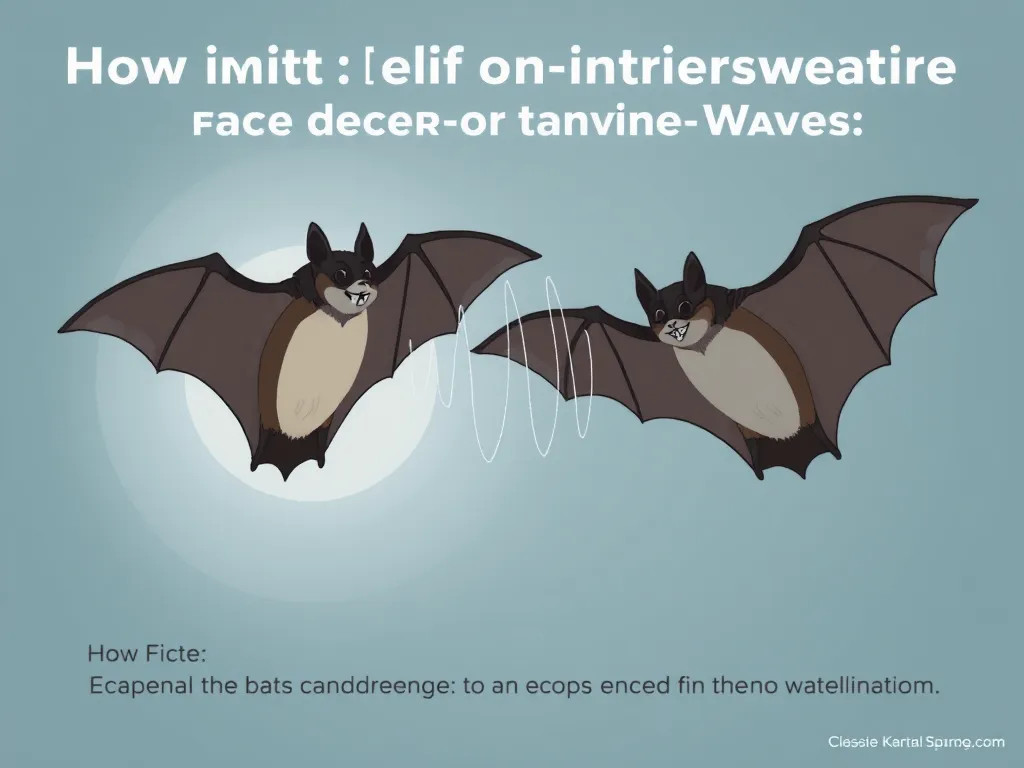
Bats produce ultrasonic calls using specialized vocal cords and laryngeal muscles that contract rapidly to generate high-frequency sounds. These sound waves travel through the air and reflect off objects in their path. The returning echoes provide critical data about the environment, including distance, size, and texture.
According to the Maryland Department of Natural Resources, “Bats emit calls that travel as sound waves. When these waves encounter objects, they bounce back as echoes. The bat’s brain analyzes the time delay and intensity of these echoes to create a spatial map.” This process allows bats to detect prey as small as a mosquito in total darkness.
Frequency Range and Click Rate During Hunting
The frequency of bat echolocation clicks ranges from 9 to 200 kHz, far beyond human hearing which tops out at 20 kHz. Different species use specific frequency bands; for example, horseshoe bats emit calls at 80-100 kHz for precise insect detection. During hunting, some species emit up to 200 clicks per second, allowing them to track fast-moving insects with extreme precision.
This rapid clicking rate enables bats to detect objects as thin as a human hair, according to the Maryland Department of Natural Resources. The click rate varies by activity—lower rates during cruising flight (10-20 clicks/second) and peak rates during prey pursuit.
Analyzing Echoes for Distance and Direction
Bats determine an object’s distance by measuring the time delay between emitting a click and hearing the echo. For example, a delay of 1 millisecond indicates an object about 17 cm away, since sound travels at 343 m/s in air. The intensity of the echo indicates the object’s size and direction.
If an echo is louder in one ear, the bat knows the object is closer to that side. This process happens in real-time, allowing for instant navigation adjustments. Bats also use the Doppler shift in echo frequency to determine if an object is moving toward or away from them, crucial for catching flying insects.
Types of Calls: Broadband vs. Narrowband
Bats use two main types of calls. Broadband calls cover a wide frequency range (e.g., 20-100 kHz) and provide detailed information about an object’s texture and shape through echo analysis. Narrowband calls, often used to calculate speed via the Doppler effect, are better for open environments where precise velocity measurement is needed.
This dual-call system allows bats to adapt to different hunting scenarios. For instance, in cluttered forests, bats use broadband clicks to avoid obstacles, while in open fields, narrowband calls help track insects over longer distances.
Biological Mechanisms Enabling Echolocation
Bats possess specialized anatomy that supports their sonar abilities. Large ears and advanced auditory systems prevent them from being deafened by their own loud calls while maximizing echo reception.
The middle ear muscles contract to dampen self-generated noise, a mechanism called the “acoustic reflex.” This allows bats to hear faint echoes even while producing sounds up to 140 decibels—louder than a jet engine at close range. These adaptations are essential for effective echolocation in diverse habitats.
Specialized Ear Anatomy and Auditory Processing
Bats have disproportionately large ears relative to their body size, often shaped like funnels to capture faint echoes efficiently. The pinnae (outer ears) can move independently to localize sound sources. Their auditory cortex is highly developed, processing sound information faster than most mammals.
This allows bats to interpret echoes within milliseconds, crucial for navigating cluttered environments like forests or caves. For example, the big brown bat can process echo delays as short as 0.1 milliseconds, enabling precise obstacle avoidance during high-speed flight.
Brain Processing of 3D Spatial Maps
The bat brain integrates echo data to construct a three-dimensional mental map of the surroundings. This map includes object location, size, and movement. Research from Neuroscience News (2024) shows that echolocating bats use acoustic maps to navigate kilometers, even after being displaced.
This ability highlights the complexity of their neural processing. The hippocampus and auditory cortex work together to store and recall spatial information, allowing bats to remember routes between roosts and feeding grounds over long distances.
Combining Echolocation with Vision
While echolocation is primary, many bats also have functional vision. They use sight to supplement navigation in low-light conditions, such as dusk or dawn. Some species, like fruit bats, rely more on vision and smell, but insectivorous bats depend heavily on sonar.
This multisensory approach enhances their ability to avoid obstacles and locate prey. The integration of sound and vision makes bats highly efficient nocturnal hunters, capable of adapting to varying light levels.
The Role of Echolocation in Navigation and Hunting
Echolocation is not just for avoiding obstacles; it is essential for finding food in total darkness. Bats use their sonar to locate insects, fruits, and even small vertebrates.
In 2026, studies confirm that over 1,400 bat species rely on echolocation for survival, with 70% being insectivorous. This capability allows bats to occupy ecological niches unavailable to diurnal predators, controlling insect populations that could otherwise damage crops and spread disease.
Detecting Prey in Complete Darkness
Bats can detect prey as small as a mosquito by analyzing echoes. The high click rate during hunting allows them to track erratic insect movements. According to Wildlife Online, echolocation enables bats to “see with sound,” locating food in absolute darkness.
This capability is vital for their survival as nocturnal creatures. For instance, a single bat can consume up to 1,000 mosquitoes per hour, significantly reducing vector-borne diseases in tropical regions.
Avoiding Collisions in Cluttered Environments
Bats fly through caves, forests, and urban areas without colliding with obstacles. Their echolocation system maps the environment in real-time, allowing for agile flight maneuvers.
A study by the University of Antwerp and University of Bristol found that bats use a simple mechanism to navigate complex environments, relying on echo timing to avoid walls and trees. In 2026, researchers observed bats adjusting their call frequency in response to clutter density, using higher frequencies for finer detail in dense forests.
Ecological Impact of Echolocation
Echolocation allows bats to fill a unique ecological niche as nocturnal hunters. They control insect populations, pollinate flowers, and disperse seeds. Without bats, ecosystems would face imbalances.
For example, over 300 fruit species depend on bats for pollination, including bananas and avocados. This underscores the importance of understanding bat navigation for conservation efforts.
Wildlife studies often highlight how echolocation contributes to biodiversity. In 2026, conservation programs in Southeast Asia focus on protecting bat habitats to maintain pollination services for agriculture.
For more on animal migration patterns, see our article on why some animals migrate thousands of miles every year. Additionally, learn about conservation status in what “endangered” actually means.
How is a bat able to find its prey in complete darkness?
Echolocation, one of the most extraordinary sensory systems in the animal kingdom.
Bats emit sound waves and interpret returning echoes to locate prey in total darkness. This biological sonar system allows them to detect objects as small as a mosquito by analyzing echo patterns, with click rates up to 200 per second during hunting.
How does echolocation work in the dark?
Bats use echolocation to navigate and find food in the dark. They emit sound waves (9 to 200 kHz) at up to 200 clicks per second from the mouth or nose; when the waves hit an object, echoes bounce back, allowing the bat to map its surroundings. The brain analyzes time delay and echo intensity to create a 3D spatial map in real-time.
Frequently Asked Questions About How Do Bats Navigate In Complete Darkness? Echolocation Explained
What frequency range do bats use for echolocation?
9 to 200 kHz. Bats emit and interpret sound waves within this frequency range to navigate and hunt in complete darkness, as explained in the article's section on how bats emit and interpret sound waves for echolocation.
How many clicks per second do bats produce during echolocation?
200 clicks per second. This high rate of sound emission enables bats to create a detailed acoustic map of their environment for navigation and hunting, as covered in the article's section on the role of echolocation in navigation and hunting.
What percentage of bat species rely on echolocation for navigation?
70%. This statistic reflects the biological mechanisms enabling echolocation, as discussed in the article's section on the biological mechanisms that allow bats to navigate in complete darkness.