The term “Endangered” on the IUCN Red List signifies a species facing a very high risk of extinction in the wild. This classification is not arbitrary; it is based on strict, quantitative criteria regarding population decline, habitat range, and population size. In 2026, the International Union for Conservation of Nature (IUCN) continues to refine these metrics to provide the most accurate assessment of global biodiversity threats.
- Endangered (EN) means a species faces a very high risk of extinction in the wild.
- A species qualifies as Endangered if its population declines by 50% to over 70% in 10 years.
- The IUCN Red List classifies species from Least Concern to Extinct, with “Threatened” covering Vulnerable, Endangered, and Critically Endangered.
How the IUCN Defines Endangered Status
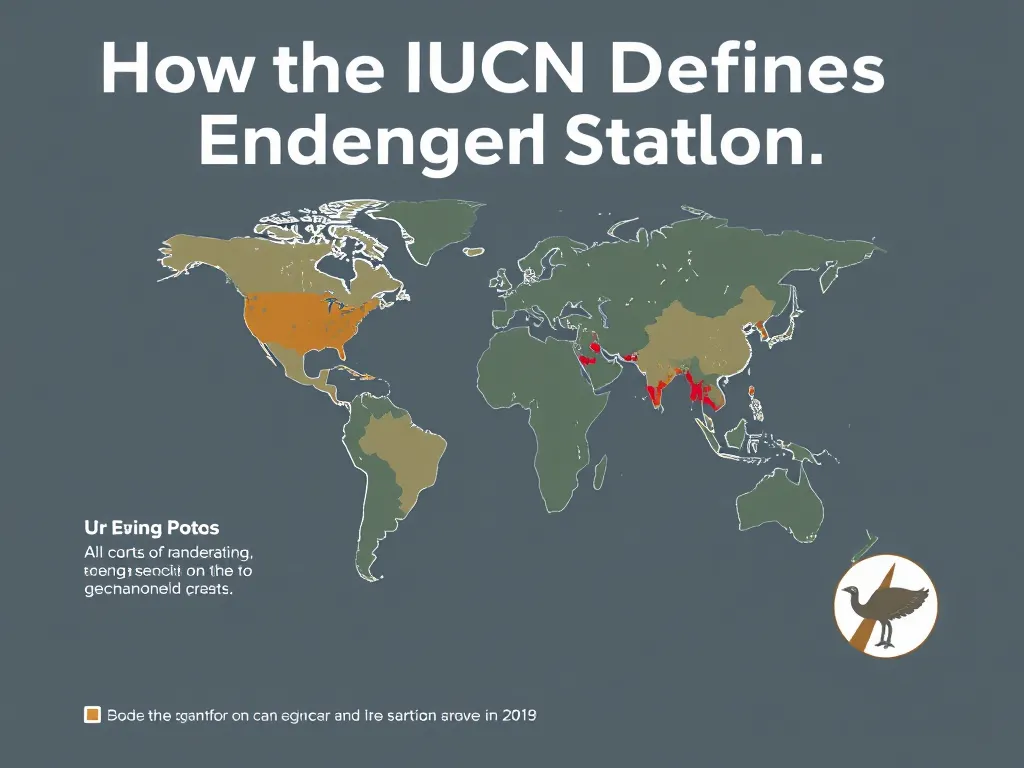
A species is classified as Endangered if it meets any of the specific criteria set by the International Union for Conservation of Nature (IUCN). These criteria are data-driven and focus on measurable threats to survival. The IUCN updates these assessments regularly, with the most recent global analysis published in late 2025, covering assessments valid through 2026.
Population Decline Criteria
The most common trigger for an Endangered listing is a rapid reduction in numbers. According to the IUCN Red List, a species must experience a population decline of at least 50% to over 70% over the past 10 years or three generations.
This rapid drop indicates severe pressure from habitat loss, overexploitation, or disease. For example, the Javan rhinoceros (Rhinoceros sondaicus) has seen its population decline by over 50% in recent decades due to poaching and habitat encroachment, securing its Endangered status.
Small Range and Fragmentation
Habitat size directly impacts survival chances. A species qualifies as Endangered if its extent of occurrence is less than 5,000 km² or its area of occupancy is less than 500 km².
When a species’ range is this small, it is highly vulnerable to localized events like fires or floods. The Sumatran orangutan (Pongo abelii), for instance, has a fragmented range across Indonesian islands, making it susceptible to deforestation and human-wildlife conflict.
Critical Population Size
Small populations face higher risks of genetic issues and random events. The IUCN criteria state that a species is Endangered if it has fewer than 2,500 mature individuals.
This threshold helps identify species that are functionally at risk even if their decline rate is not yet extreme. The vaquita (Phocoena sinus), a small porpoise in the Gulf of California, has an estimated population of fewer than 10 individuals, highlighting the urgency of its Endangered classification.
Extinction Probability Thresholds
Mathematical models predict future risks. A species is listed as Endangered if there is a calculated probability of extinction in the wild of at least 20% within 20 years or five generations.
This forward-looking metric captures species that are currently stable but face looming threats. For instance, some coral species are listed as Endangered not because of current population crashes but due to projected declines from ocean warming and acidification.
The IUCN Red List Risk Spectrum
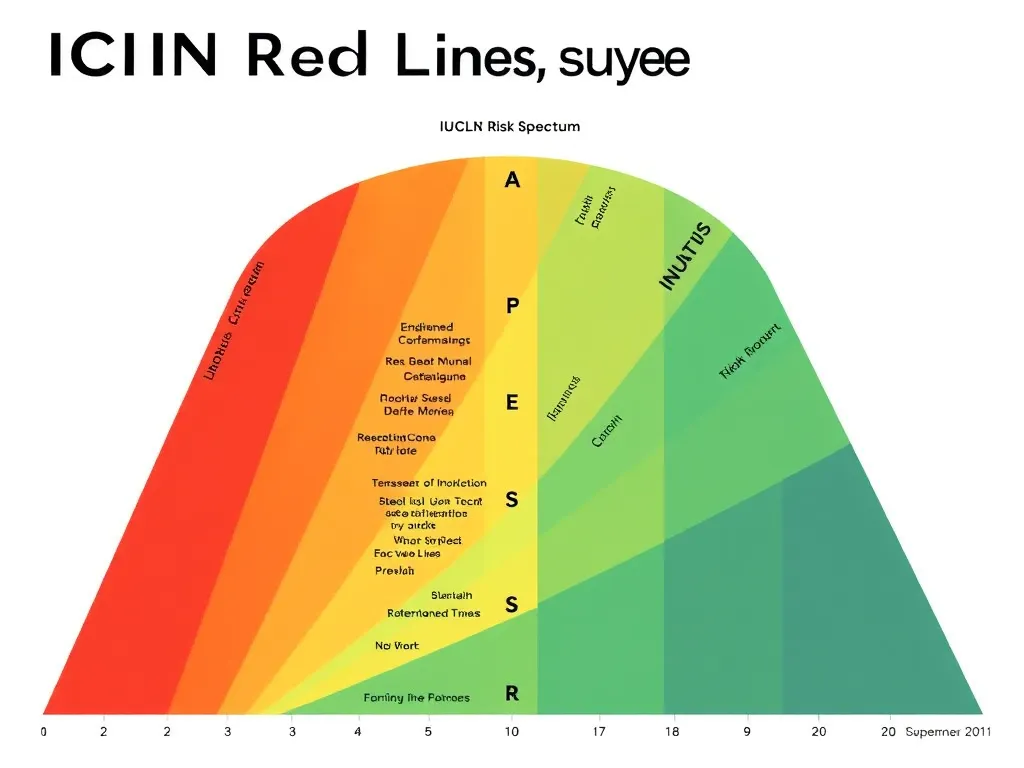
The IUCN Red List organizes species into a hierarchy of risk, from the safest to the most critical. Understanding this spectrum helps clarify where “Endangered” fits within global conservation efforts. The list is updated continuously, with over 160,000 species assessed as of 2026.
The Threatened Categories
The IUCN groups three specific categories under the umbrella term “Threatened.” These represent species at high risk of vanishing without intervention.
- Vulnerable (VU): Species facing a high risk of extinction in the wild. This category includes species with a population decline of 30-50% over 10 years or three generations.
- Endangered (EN): Species facing a very high risk of extinction in the wild. This category requires a decline of 50-70% or meeting specific range and population size criteria.
- Critically Endangered (CR): Species facing an extremely high risk of extinction in the wild. This category requires a decline of over 80% or other severe thresholds.
According to the IUCN Red List Frequently Asked Questions, these three categories are collectively described as ‘threatened’ because they all require significant conservation action to prevent extinction. In 2026, the IUCN emphasizes that “Threatened” is a policy term used in international agreements like the Convention on International Trade in Endangered Species (CITES).
Beyond Threatened: The Full Spectrum
The risk spectrum extends beyond threatened status to include both safer and more severe classifications.
- Least Concern (LC): Widespread and abundant species. These species do not qualify for threatened status and are considered safe from extinction in the near term.
- Near Threatened (NT): Species close to qualifying for a threatened category. These species require monitoring to prevent future declines.
- Extinct in the Wild (EW): Species known only to survive in captivity or cultivation. Examples include the Scimitar-horned oryx, which has been reintroduced from captive populations.
- Extinct (EX): Species where no reasonable doubt exists that the last individual has died. The last confirmed sighting of the Western black rhinoceros was in 2000, and it was declared extinct in 2011.
This structure allows conservationists to prioritize efforts. For example, a species listed as Endangered requires more immediate action than one listed as Vulnerable, but less than one listed as Critically Endangered. The IUCN also includes categories like “Data Deficient” for species lacking sufficient information.
Data-Driven Assessments
The IUCN Red List is not a legal instrument but a scientific database. Assessments are based on data regarding population size, rate of decline, and habitat range.
The system acknowledges that a species can be Endangered in one region but of Least Concern in another, depending on local population health. For instance, the African elephant (Loxodonta africana) is listed as Vulnerable globally but Endangered in specific regions like Central Africa due to localized poaching pressures.
Distinction Between Threatened and Endangered
While often used interchangeably in casual conversation, “Threatened” and “Endangered” have distinct meanings within the IUCN framework. Understanding this difference is crucial for accurate conservation communication and policy-making in 2026.
“Threatened” as an Umbrella Term
“Threatened” is a collective term used by the IUCN to describe species at risk. As noted by the IUCN Red List, species in the Vulnerable, Endangered, and Critically Endangered categories are all considered threatened.
This grouping helps streamline policy discussions and legal protections, such as those under CITES, which lists threatened species for trade restrictions. In 2026, the term “threatened” is increasingly used in national legislation to trigger conservation funding and habitat protection measures.
“Endangered” as a Specific Status
“Endangered” is a precise classification with defined criteria. It sits between Vulnerable and Critically Endangered on the risk spectrum. A species listed as Endangered meets one or more of the strict quantitative thresholds discussed earlier, such as a population decline of 50% or more.
This specificity allows for targeted interventions. For example, the Amur leopard (Panthera pardus orientalis) is Endangered due to a population of fewer than 100 individuals in the wild, requiring focused anti-poaching and habitat restoration efforts.
Practical Implications
The distinction matters for resource allocation. A “Threatened” species might be Vulnerable, requiring monitoring, while an “Endangered” species often needs immediate, intensive intervention.
The IUCN Red List provides this granularity to guide effective conservation strategies. In 2026, conservation organizations like the World Wildlife Fund (WWF) use IUCN categories to prioritize funding, with Endangered species receiving higher priority than Vulnerable ones.
For more details on how these categories differ, see our guide on the difference between Vulnerable, Endangered, and Critically Endangered.
The Role of the IUCN in Global Wildlife Conservation
The International Union for Conservation of Nature (IUCN) is the global authority on the status of the natural world. Founded in 1948, this Swiss-based organization compiles the Red List to influence policy and guide conservation actions worldwide. In 2026, the IUCN continues to expand its assessments to include more species and refine its criteria based on new data.
IUCN’s Mission and Structure
The IUCN’s mission is to “influence, encourage and assist societies throughout the world to conserve nature.” It comprises over 1,400 member organizations and involves some 16,000 scientists and experts. The organization does not mobilize the public directly but works to influence governments and businesses through data and advice. In 2026, the IUCN has launched new initiatives to integrate climate change projections into species assessments, recognizing that warming temperatures are a growing threat to biodiversity.
The Red List’s Global Impact
Since its founding in 1964, the IUCN Red List has assessed over 150,000 species. As of 2025, 44,000 species are considered at risk of extinction due to human activity, with 28% of assessed species falling into threatened categories. This data informs international conventions and national laws, though the Red List itself is not a legal instrument.
For example, the Endangered Species Act in the United States references IUCN data for listing decisions. In 2026, the IUCN reports that 1 million species face extinction threats, highlighting the urgency of conservation action.
Connecting Conservation Efforts
The IUCN Red List links to various conservation topics, such as animal migration patterns and echolocation in bats. Understanding extinction risks helps explain why some animals migrate thousands of miles or how species adapt to survive in darkness.
For instance, migratory birds like the Arctic tern face habitat loss along their routes, contributing to their Endangered status in some regions. The IUCN also collaborates with other organizations to address cross-cutting issues like invasive species and pollution.
Conclusion
The term “Endangered” is a scientific classification with specific meaning. It indicates a very high risk of extinction based on measurable criteria like population decline, habitat loss, and small population size.
The IUCN Red List provides a clear framework for understanding these risks, distinguishing between Vulnerable, Endangered, and Critically Endangered statuses. In 2026, with biodiversity loss accelerating, accurate classification is more critical than ever for guiding global conservation efforts.
One surprising fact is that a species can be listed as Endangered even if its population is currently stable, provided mathematical models predict a 20% extinction probability within 20 years. To support wildlife conservation efforts, consider exploring resources on Wildlife protection and habitat preservation. Action steps include supporting IUCN member organizations or participating in local habitat restoration projects, which can be found through the IUCN website.