The mantis shrimp delivers punches with the force of a .22 caliber bullet, reaching speeds of 50 mph and generating 1,500 Newtons of force through a remarkable biological spring mechanism. These colorful crustaceans, typically just 10 centimeters long, pack one of the most powerful strikes in the animal kingdom, capable of shelling prey and even cracking aquarium glass while somehow surviving the immense impact themselves.
- Mantis shrimp store energy in a specialized saddle-shaped structure, similar to a biological crossbow
- Their punches reach 50 mph (23 m/s) in less than a millisecond, faster than a .22 caliber bullet
- Cavitation bubbles create a secondary shockwave, making the strike even more powerful
- The dactyl clubs have a multilayered structure that allows the shrimp to withstand its own impact
The Biological Mechanism Behind the Mantis Shrimp’s Bullet-Like Punch
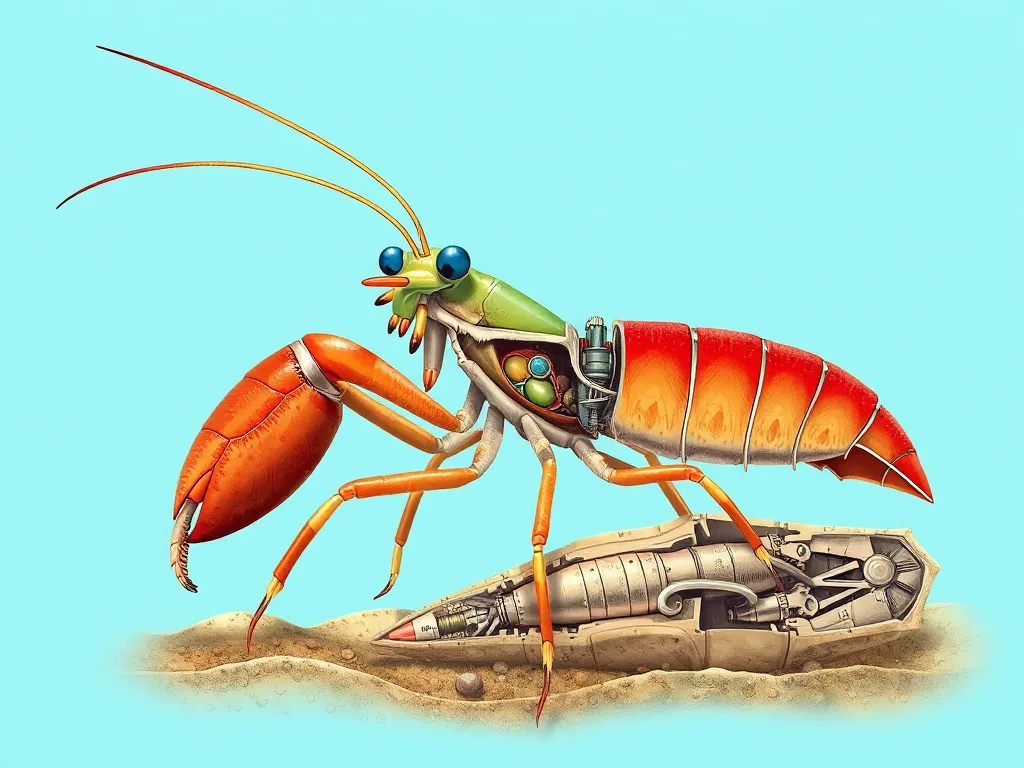
The Saddle-Shaped Energy Storage System: Nature’s Crossbow
The mantis shrimp’s power comes from a specialized saddle-shaped structure on its raptorial appendage that stores elastic energy like a biological crossbow. This remarkable structure, located on the arm just above the shrimp’s club, allows the shrimp to build up tremendous potential energy that can be released instantaneously.
Huge extensor muscles continuously compress this saddle-shaped area, storing energy until the moment of release. Unlike most crustaceans that rely solely on muscle power for movement, the mantis shrimp has evolved this sophisticated energy storage system that gives it a mechanical advantage far beyond what its small muscle size would suggest.
The Latch Mechanism: Releasing Stored Energy Instantaneously
The mantis shrimp’s punch relies on an ingenious latch mechanism that releases stored energy with incredible speed:
- Four-bar mechanism: Acts as a biological latch to hold the club in place until the precise moment of release
- Instant energy conversion: Converts potential energy into kinetic energy in less than a millisecond
- Minimal friction: The latch design reduces energy loss during the release process
- Precise timing: Allows the shrimp to control exactly when the stored energy is unleashed
This system works similarly to a crossbow or spring-loaded trap, storing energy until the latch is released, then converting that stored potential energy into kinetic energy with remarkable efficiency.
Muscle Power vs. Mechanical Advantage: How the Shrimp Stores Energy
Despite their small size—most mantis shrimp average just 10 centimeters in length—these crustaceans generate force comparable to a .22 caliber bullet. The secret lies in the mechanical advantage provided by the saddle-shaped structure. While the shrimp’s extensor muscles are relatively large compared to its body size, they couldn’t possibly generate 1,500 Newtons of force through muscle power alone.
Instead, the saddle-shaped structure allows the shrimp to store energy over time, then release it in an explosive burst. This biological spring mechanism gives the mantis shrimp a power-to-weight ratio that makes it one of the most formidable strikers in the animal kingdom.
The Physics of the Mantis Shrimp’s Strike: Speed, Force, and Cavitation
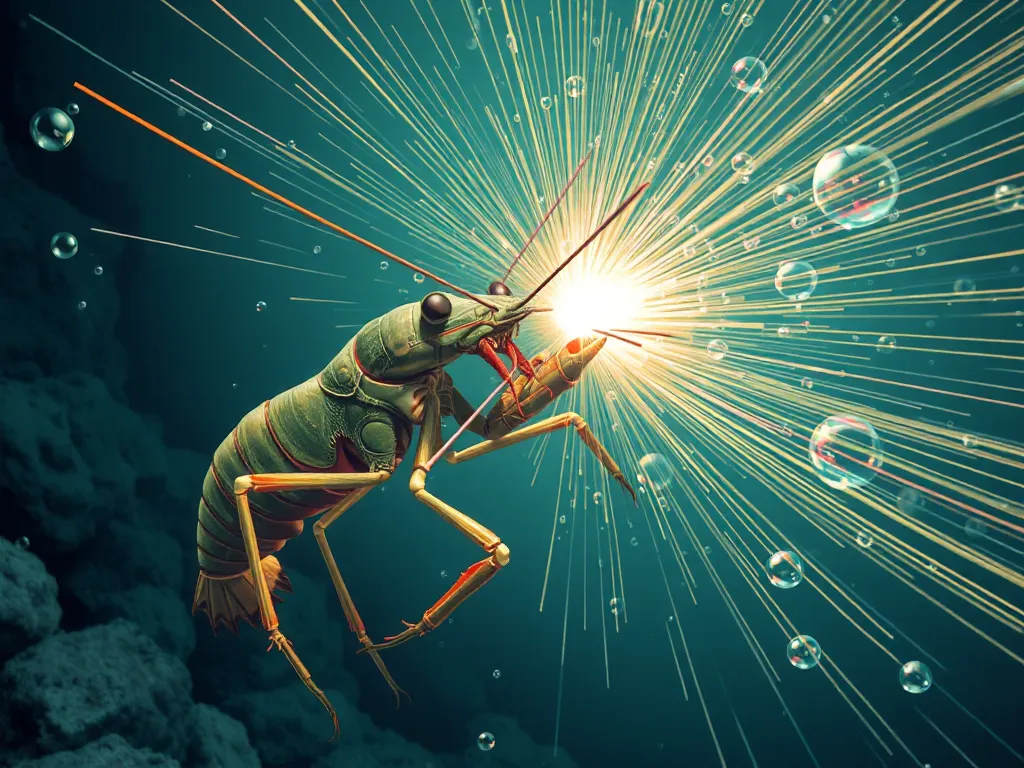
50 mph in Less Than a Millisecond: The Shocking Speed of the Strike
The mantis shrimp’s punch accelerates at a rate comparable to a .22 caliber bullet, reaching speeds of 50 mph (23 meters per second) in less than a millisecond. This incredible acceleration makes it one of the fastest movements in the animal kingdom. To put this in perspective, if a mantis shrimp were the size of a human, its punch would travel at speeds exceeding 400 mph.
The shrimp achieves such remarkable speeds through the combination of stored elastic energy and the mechanical advantage of its raptorial appendage. This velocity allows the strike to reach its target before the prey can even react, making it an incredibly effective hunting and defensive mechanism.
1,500 Newtons of Force: Measuring the Power of the Punch
The mantis shrimp generates 1,500 Newtons of force with each punch—equivalent to the force of a .22 caliber bullet. To understand what this means in practical terms:
- This force is strong enough to shatter mollusk shells and crack aquarium glass
- It’s more than 250 times the shrimp’s body weight
- The force concentration at the tip of the dactyl club creates pressure that exceeds 150,000 pounds per square inch
- This level of force can split human skin to the bone, as unfortunate aquarium owners have discovered
The combination of this tremendous force with the incredible speed of the strike creates a devastating impact that can instantly incapacitate or kill prey, even if the initial strike appears to miss its target.
Cavitation Bubbles: The Double Strike Effect That Stuns Prey
One of the most remarkable aspects of the mantis shrimp’s punch is the cavitation effect it creates. The strike is so rapid that it creates a low-pressure area in the water, producing cavitation bubbles. These bubbles then implode violently, creating a secondary shockwave that produces heat and light.
This secondary strike can be even more damaging than the initial impact, stunning or killing prey even if the punch appears to miss. The cavitation effect essentially creates a “double strike” phenomenon, making the mantis shrimp’s attack incredibly difficult to evade. This biological weapon demonstrates how evolution has crafted solutions that go beyond simple mechanical force, incorporating complex physics to maximize effectiveness.
How Mantis Shrimp Withstand Their Own Devastating Punch
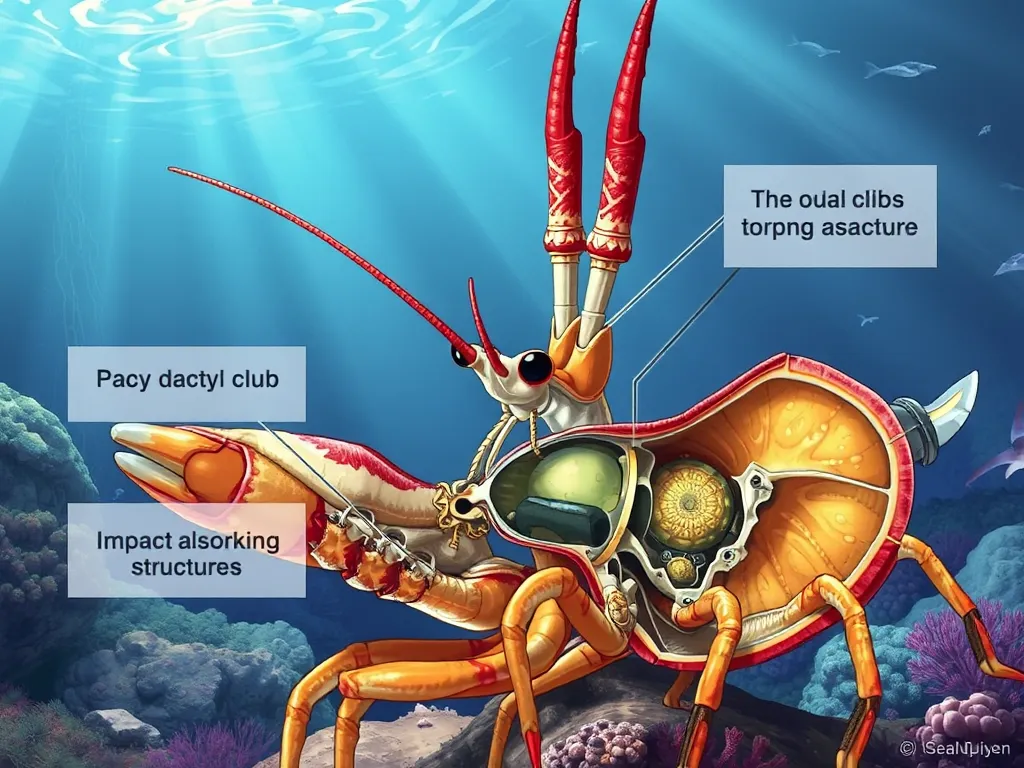
The Dactyl Club’s Multilayered Structure: Built to Withstand Impact
The most astonishing aspect of the mantis shrimp’s punch is that it delivers such devastating force without harming itself. This is possible due to a sophisticated, multilayered, damage-tolerant microstructure in the dactyl clubs. These clubs are not simple hammer-like structures but complex biological engineering marvels.
The outer layer is designed to disperse energy and resist cracking, while the inner structure acts as a shock absorber for high-frequency impact waves. This multilayered design allows the dactyl club to withstand the same force it delivers to prey, preventing the shrimp from injuring itself with its own powerful strikes—a biological puzzle that has Why the Platypus Confused Scientists for Decades After Discovery.
Herringbone and Bouligand Structures: Engineering Solutions in Nature
| Structure Type | Location | Function |
|---|---|---|
| Herringbone Structure | Outer layer of dactyl club | Disperses energy and resists cracking upon impact |
| Bouligand Structure | Inner layer of dactyl club | Acts as a shock absorber for high-frequency impact waves |
These specialized structures are made from a tough combination of chitin and hydroxyapatite, creating a material that’s both lightweight and incredibly durable. The herringbone pattern in the outer layer helps distribute impact forces, while the Bouligand structure in the inner layer absorbs the high-frequency vibrations that could otherwise damage the club. This combination of materials and structures creates a biological solution that human engineers are only beginning to understand and replicate.
How the Shrimp Absorbs Shockwaves: Protecting Itself From Its Own Power
Recent research from February 2025 has revealed how mantis shrimp withstand the intense shockwaves created by their own powerful strikes. The shrimp’s body has evolved specialized mechanisms to absorb and dissipate the energy from its punch, preventing self-injury. This includes unique joint structures that allow the arm to move without transmitting damaging vibrations to the rest of the body.
Additionally, the mantis shrimp’s exoskeleton has reinforced areas that can withstand the pressure waves generated by its strike. These adaptations allow the shrimp to deliver blows with the force of a .22 caliber bullet while remaining completely unharmed—a feat that continues to fascinate scientists studying bioengineering and biomechanics.
The mantis shrimp’s punch mechanism represents one of nature’s most remarkable examples of bioengineering, with solutions that human engineers are only beginning to understand, similar to how How the Naked Mole Rat Became Biology’s Most Studied Animal. To see this incredible mechanism in action, watch Dr. Ben Miles’ 2025 video “Mantis Shrimp Punch at 40000 fps! – Cavitation Physics” that breaks down the physics behind this natural marvel.
The study of these remarkable creatures continues to provide insights that could revolutionize fields from materials science to medicine, demonstrating how much we still have to learn from the natural world, as seen with Why Horseshoe Crabs Are More Important to Human Medicine Than You Realize. For more fascinating wildlife adaptations, explore the wildlife resources that showcase nature’s most remarkable engineering solutions.
Frequently Asked Questions About How The Mantis Shrimp Punches With The Force Of A Bullet
How fast is a mantis shrimp's punch?
50 mph. This rapid speed allows the mantis shrimp to deliver one of the fastest strikes in the animal kingdom, generating immense force.
How much force does a mantis shrimp punch generate?
1,500 Newtons. This force is comparable to a .22 caliber bullet, enabling it to smash shells and other hard materials.
How does the mantis shrimp withstand its own punch?
The dactyl club features an outer herringbone structure that disperses energy and resists cracking, and an inner bouligand structure that absorbs high-frequency impact waves.
What structures protect the mantis shrimp during impact?
The outer herringbone structure resists cracking, while the inner bouligand structure acts as a shock absorber for high-frequency waves.